


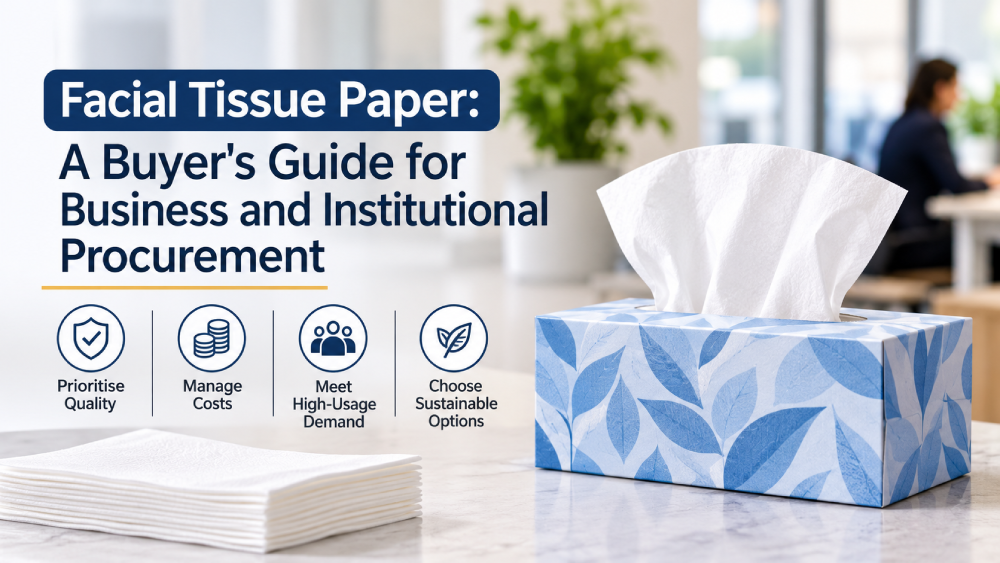
Facial tissue paper is one of the more frequently purchased items in institutional supply chains and one of the least scrutinised. Most procurement decisions default to familiarity or price, with little attention paid to quality parameters that directly affect performance, user experience, and the organisation’s sustainability commitments.
At meaningful scale, whether a hotel chain, hospital network, or corporate campus, tissue paper procurement decisions accumulate. The wrong specification leads to quality complaints, dispenser incompatibility, excessive usage per interaction, and gaps in sustainability documentation for organisations that need to account for their input materials.
What Facial Tissue Is Made Of
Standard facial tissue is produced from cellulose fibres, from either virgin wood pulp or post-consumer recycled content. The quality of the raw material affects softness, absorbency, and wet strength in ways that become visible in daily use.
Better-grade tissue uses chlorine-free processed pulp (TCF or ECF) to eliminate chlorine compounds from both the product and the wastewater from its production. Lower-cost options often compromise at this stage, producing a product that performs less consistently on skin contact and breaks down more unpredictably in waste streams.
For buyers specifying institutional tissue, understanding the raw material base and processing method is the starting point for an informed procurement decision.
Key Quality Parameters for Institutional Use
Softness Grade
Tissue is produced across multiple softness grades. For guest-facing applications in hospitality such as hotel rooms and executive lounges, higher softness grades improve the guest experience. For general office or public restroom contexts, a mid-grade product satisfies functional expectations at a controlled cost.
Ply Count
Two-ply tissue provides better perceived quality and is more efficient per use than single-ply at equivalent sheet width. Single-ply is appropriate in very high-volume settings where cost per interaction is the primary driver and quality perception is secondary.
Absorbency and Wet Strength
A tissue that loses structural integrity when wet is a poor performer regardless of its dry softness. Wet strength additives allow the sheet to hold together during use. Buyers should test absorbency and wet strength performance before finalising a supplier, using the actual dispenser format in the intended use context.
Sheet Dimensions and Pack Format
Institutional pack formats differ substantially from consumer SKUs. The box count, sheet size, and interfolding format must be compatible with existing dispensers. Specifying formats that do not fit installed hardware creates operational problems and drives up cost per unit through increased waste.
Biodegradability and Disposal in Commercial Settings
A frequently asked question in institutional procurement: is facial tissue biodegradable? The answer depends on what the tissue contains. Tissue made from natural cellulose without synthetic additives biodegrades readily under standard conditions. Products with wet strength resins, wax coatings, or lotion treatments break down more slowly, and the rate varies significantly by formulation.
Buyers should request specific biodegradability data from suppliers and verify that it applies to the full product, not only the base paper. For organisations with sustainability reporting obligations, procurement of certified biodegradable tissue creates a documentable environmental improvement.
One point that operations teams should communicate clearly: facial tissue should not be flushed. Unlike toilet paper, which is engineered to dissolve rapidly in water, facial tissue retains its structural integrity and can cause plumbing blockages in commercial systems.
What to Look for in a Supplier
At institutional volumes, supplier reliability matters as much as product quality at the point of initial evaluation. Key supplier selection criteria:
- Consistent batch quality. The tissue delivered on the fifth order should match the sample provided at evaluation stage. Request quality certificates batch-by-batch as a standard contract condition.
- Range of pack formats. A supplier covering pocket packs, box tissue, and interfolded dispenser formats reduces the number of vendors to manage and simplifies procurement administration.
- Documented sustainability credentials. FSC or PEFC certification confirms responsible wood sourcing. Suppliers should provide this without being asked.
- Reliable lead times and minimum order quantities that match operational procurement cycles, not only volumes attractive to the supplier.
Working With Pudumjee Paper Products
We supply facial tissue paper to institutional buyers across India in multiple softness grades, ply specifications, and pack formats. Our products are produced with chlorine-free processed pulp and documented to support sustainability reporting requirements.
Our team works directly with procurement managers to match product specifications to use-case requirements, dispenser compatibility, and volume planning needs.
To request samples or discuss specifications for your institutional tissue requirements, contact our team at pudumjee.com.