
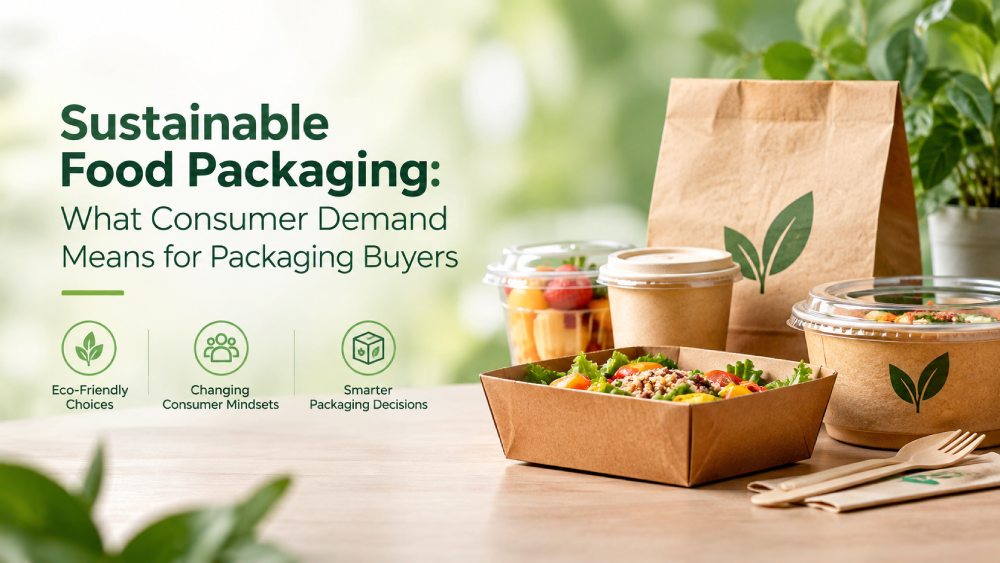
Food packaging decisions that once sat entirely within procurement are now surfacing in brand conversations. Consumer behaviour in urban India has made packaging sustainability a commercial variable, not just an ethical preference. For companies buying packaging at scale, that shift has direct implications for what they specify, source, and defend to their supply chain partners.
What the Numbers Are Telling Procurement Teams
61% of urban Indian consumers factor sustainable packaging into food purchasing decisions. 43% say they will pay more for a product with eco-friendly packaging. These are not fringe preferences. They represent a measurable demand signal that sits upstream of brand performance. A food company moving from plastic toward paper-based packaging is not making a purely environmental statement. It is responding to a commercial signal with quantifiable weight.
India generates approximately 10.2 million tonnes of plastic waste annually, with food packaging accounting for a significant share. Regulatory pressure is building alongside consumer expectation. For procurement teams, acting ahead of that pressure is considerably more cost-effective than reacting to it.
What Sustainable Food Packaging Actually Requires
The term is used loosely and often commercially. In practice, packaging qualifies as genuinely sustainable only when it satisfies three conditions simultaneously: it protects the product reliably across transit and storage, it complies with applicable food safety standards, and it has a practical end-of-life path through recycling, composting, or biodegradation.
Paper-based packaging fits this profile better than most available alternatives when the right grade is specified for the application. The shift is not sentimental. It is a response to regulatory momentum, supply chain accountability, and the cost of staying relevant with a consumer base that now reads labels differently.
Types of Paper Used in Food Packaging
Different food applications demand different paper properties. Mismatched choices lead to product spoilage, compliance gaps, and unnecessary cost. The main categories serve distinct purposes:
- Greaseproof paper is used for bakery products, oily snacks, and fast food applications where oil migration would compromise the pack or the product inside it.
- Parchment paper handles direct heat contact in commercial food production environments, resisting moisture and high temperature without breaking down.
- Kraft paper suits dry food products, outer bags, and printed packaging where tensile strength and printability are the primary considerations.
- Specialty barrier papers serve products requiring moisture or vapour control during transit and storage.
Specifying the right grade requires supplier knowledge and application understanding working together. It is not a catalogue selection exercise.
What to Specify When Sourcing
When evaluating food-grade paper suppliers, price is one input among several that matter equally in the long run:
- Grease resistance rating tested against established standards, not supplier claim alone.
- Food contact compliance with FSSAI requirements, and for export product lines, with EU or FDA food contact standards.
- Documented biodegradability with clear end-of-life guidance and verifiable data, not marketing language.
- Supplier transparency on raw material sourcing, production process, and any chemical treatments applied.
Vague environmental claims from a supplier are a gap in due diligence, not a sign of alignment.
Working With Pudumjee Paper Products
We supply greaseproof, parchment, and specialty papers for food packaging to manufacturers, quick-service restaurant chains, bakeries, and packaging converters across India. Our materials are designed for direct food contact applications and documented to support audit-ready procurement records.
If you are reviewing your food packaging paper specifications or evaluating alternatives to plastic-based materials, our team can support that process with technical consultation and samples for trial.
To discuss your food packaging paper requirements or request trial samples, contact our team at pudumjee.com or reach out to your nearest regional sales office.