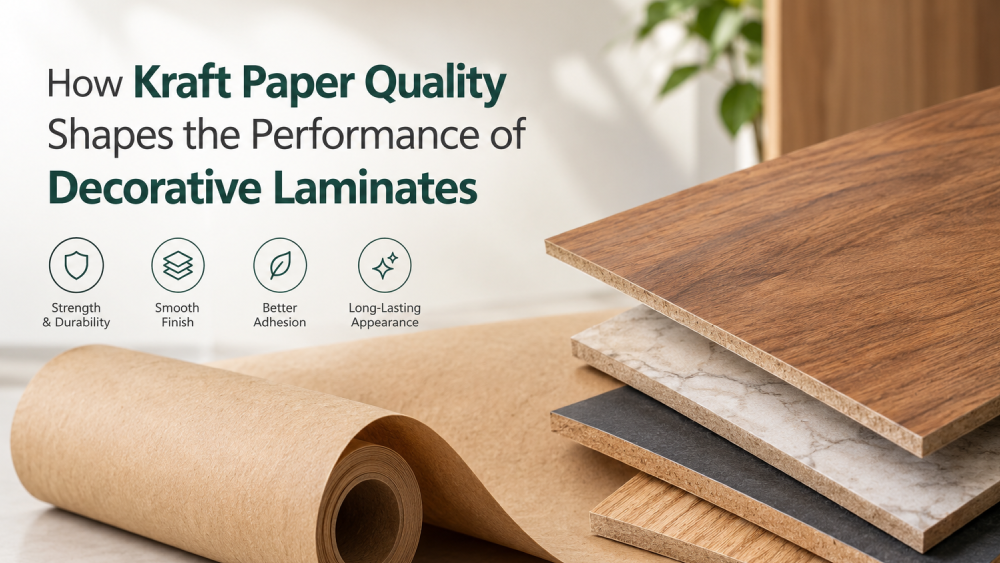
The laminate surfaces used in offices, kitchens, retail interiors, and commercial furniture are the visible output of a manufacturing process that begins with paper. The quality and consistency of the kraft paper used as a base layer in decorative laminates determines how the finished product absorbs resin, bonds under pressure, resists moisture, and holds its surface integrity across years of use.
For laminate manufacturers and HPL producers, this is not an abstract specification consideration. The wrong paper grade creates problems that surface only after production: uneven resin absorption, inconsistent surface finish, dimensional instability, or delamination under humidity. Choosing the right paper supplier is a technical decision with direct consequences for production consistency and end-product quality.
The Role of Kraft Paper in Laminate Construction
Decorative laminates, whether high-pressure (HPL) or low-pressure (LPL), are built from layered paper sheets saturated with thermosetting resins and bonded under heat and pressure. The structural core of the laminate depends on absorbent kraft paper, specifically designed to accept resin uniformly during the impregnation process.
What makes kraft paper suitable for laminate manufacturing is a combination of controlled properties: porosity that allows resin penetration at the correct rate, tensile strength that prevents tearing during roll handling and pressing, and dimensional stability that holds consistent across roll widths and production batches. Variation in any of these properties produces variation in the finished laminate.
The decorative surface layer is what buyers and designers see. The kraft layers beneath it are what give the laminate its structural depth, impact resistance, and long-term performance.
Key Paper Properties That Laminate Manufacturers Should Specify
Resin Absorption Rate
The porosity of the kraft paper governs how quickly and how completely resin penetrates during impregnation. Under-absorption produces dry spots and surface defects. Over-absorption leads to brittleness and reduced flexibility. Laminate manufacturers should work closely with their paper supplier to align paper porosity with the specific resin systems in use.
Tensile Strength and Tear Resistance
Kraft paper moves through mechanical tension during web handling, slitting, and press loading. Paper that tears under process conditions creates waste, production stops, and quality inconsistency. Industrial-grade absorbent kraft paper is engineered to handle these loads reliably across long production runs.
Moisture Content and Dimensional Stability
Kraft paper with variable moisture content before impregnation causes dimensional changes that carry through to the finished laminate surface. Consistent moisture levels from roll to roll are a basic supplier quality standard that matters significantly in production.
Grammage Consistency
The GSM of the kraft paper must hold within specified tolerances across each roll and across batches. GSM variation changes the structural thickness of the laminate, producing products that fall outside specification and require costly rework or rejection.
The Sustainability Case for Recycled Absorbent Kraft Paper
Laminate manufacturers are facing questions from their downstream customers about the sustainability of input materials. Recycled absorbent kraft paper is an established alternative to virgin kraft in laminate construction, and its environmental credentials are well-documented.
Each tonne of recycled kraft paper used in place of virgin pulp saves approximately 17 trees, 7,000 gallons of water, and 4,000 kilowatts of energy, while reducing process-related air emissions compared to conventional kraft pulping.
For manufacturers supplying to construction and interior design markets where green building certification is a customer requirement, using recycled-content laminate paper supports the materials documentation needed for LEED and IGBC credit claims.
Working With Pudumjee Paper Products
We manufacture absorbent kraft paper specifically for the decorative laminate industry. Our products are produced to consistent grammage, porosity, and tensile specifications. We work directly with laminate manufacturers to calibrate paper properties to their production process and resin systems.
Our range includes both standard and recycled-content grades, giving manufacturers the flexibility to meet sustainability targets without significant process changes.
If you are evaluating your kraft paper supply for laminate production, our team can provide technical consultation, roll specifications, and trial material matched to your production requirements.
Contact our technical sales team at pudumjee.com to discuss kraft paper specifications for your laminate production.